I was delighted to write an article for Prime Resi, providing its readers with Six ways property leaders can create clarity, build stronger teams and make better decisions in uncertain times.
The article below was published in their journal on 16th October 2026.
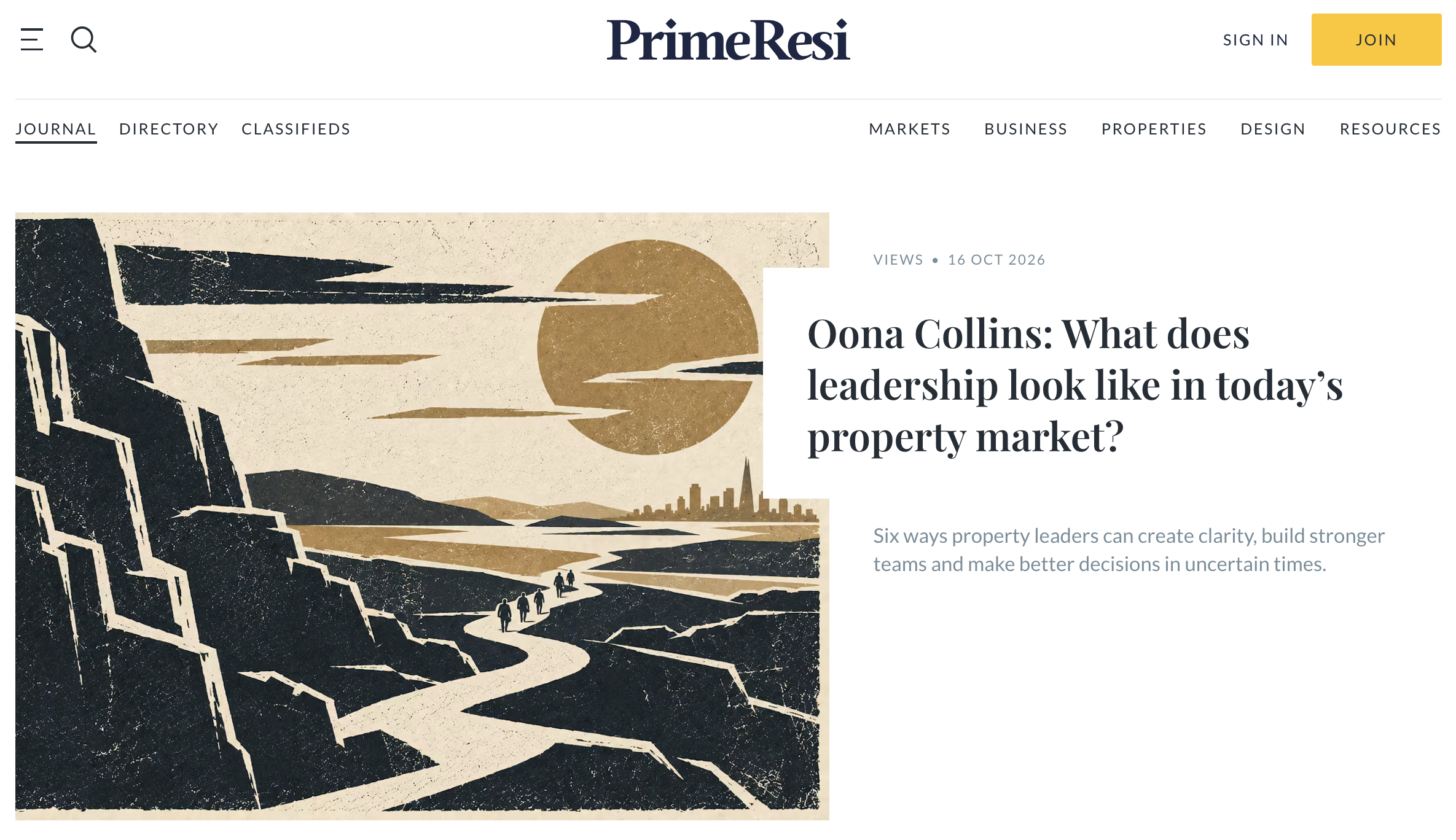
If there is one thing real estate leaders would like more of right now, it is certainty.
Certainty over tax, interest rates, government policy, planning and regulation – and increasingly, over where capital and opportunity will move next.
But certainty is in short supply, and it is rarely how leadership works.
After 15 years in property and 25 years supporting CEOs, founders and executive teams across the sector, I have learned that the strongest leaders and businesses do not wait for the market to settle. They create clarity while things are still uncertain.
Here are six ways leaders can do that…
1. Create confidence when others feel uncertain
Confidence is one of the most valuable assets a leader can create, particularly when maintaining margins is becoming harder.
A conversation with a seasoned CEO of a residential development company brought this into sharp focus. Leaders across the sector are being squeezed between rising construction costs, high landowner expectations, inflated acquisition prices and buyer affordability.
When margins slip, morale and retention can suffer as profits and bonus pools shrink.
His response was not to hide the numbers. His team shares management information openly and is candid when bonuses are not what they would like to give. More importantly, they give people a credible plan for improving performance – through better-designed schemes, tougher negotiations, design innovation, tighter cost control, new opportunities and technology that frees people to focus on income generation.
When people see a transparent, credible plan that benefits them, they stay engaged and trust the direction of the business.
2. Review the strategy, not simply the targets
Harder markets force more deliberate choices.
Growth is not simply about hitting the next revenue target. It is about being prepared to pivot, reconsider where you compete and make difficult choices about where sustainable demand and margin exist.
We are seeing agents, developers and property businesses look beyond traditional boundaries and ask where the right customer profile, genuine demand and sustainable margins exist.
Landsec, for example, has responded to a higher-inflation, higher-rate environment by focusing on locations with strong demand, reducing speculative development and disposing of lower-returning assets. Berkeley Group has adapted its Berkeley 2035 strategy, rephasing delivery and expanding its Berkeley Living BTR platform.
Other businesses are looking beyond London and the M25 into the wider South of England, purpose-built rental and student accommodation.
But strategic change does not mean abandoning the qualities that built the brand. Cutting landscaping, space standards or other aspects of product quality for short-term savings can undermine long-term value.
Strategy requires discipline: knowing where you genuinely have an advantage and having the courage to say no.
3. Build the structure that allows you to grow
The entrepreneurial behaviours that get a business off the ground can become the very things that constrain it as it grows.
For leaders considering further expansion, institutional investment, partnerships or an eventual exit, the foundations for growth matter.
Is decision-making overly dependent on a small group of founders? Are accountability and management structures robust enough for a larger business? Can the operational infrastructure support twice the volume without burning out key people?
I worked with a founder-led property consultancy that had grown for more than a decade but had never fundamentally changed its culture or structure. When growth stalled, the founders recognised that the business could no longer operate like an SME. They invested in their senior talent and began recruiting a CEO with a remit to structure the business for its next stage.
Growth does not fix weak foundations. It magnifies them.
4. Build the team for where you are going
It is easy to recruit reactively around today’s operational problems. Strong leaders think further ahead.
One CEO recently described how they deliberately create a five-year development plan for their people, with clear progress they can see each year. Crucially, they also ask individuals what changes they would make and where they see opportunities for their own development.
That combination of structure and ownership is powerful. People can see where they are going, but they also have a voice in shaping their career growth.
An executive I worked with was interested in developing an area of the business where she could see an opportunity. Her CEO gave her the opportunity to build and run the new service area. The promotion came earlier than expected, but he was clear about the faith he had in her and the role he believed she could play in the future of the business.
If talented people cannot see a future with you, eventually they will find one somewhere else. Developing people is not simply a retention strategy; it is how leaders build the capability the business will need next.
5. Get closer to clients and keep good advisers close
When markets become difficult, the quality of the advice around a leader becomes critical.
The best leaders I see tend to have a small circle of advisers whose judgement they genuinely trust. There is a significant difference between appointing a professional services firm and having an adviser who understands your business, knows the detail and is prepared to tell you what you may not want to hear.
The advisers who prove their worth in tough cycles share distinct qualities. They are frank, prepared and commercially aware. They understand the underlying legal and financial material, challenge assumptions and remain honest when conditions deteriorate providing clear guidance without trying to make the final executive decision for you.
In a tight-margin, complex market, good advice is not a luxury. It is risk management.
6. Build a culture that can handle difficult conversations
Uncertainty tests culture quickly.
High-performing leadership teams are not places where everyone nods in agreement. They are environments where people can challenge plans, debate difficult issues and surface bad news early.
Leaders need to make it safe to ask whether a strategy is still working, whether a project remains viable or whether an assumption made six months ago is still true.
Two questions can be particularly powerful:
- What are we seeing that we are not yet acting on?
- If we were starting again today, what would we do differently?
If people cannot challenge the prevailing view, leaders eventually make decisions in a vacuum.
Build for what comes next
At a property conference earlier this year, CEOs were asked what they believed their own strengths were as leaders.
One described a healthy level of “paranoia” – continually asking what if? rather than simply continuing to do what has always been done. Another talked about drawing data from different sources to avoid missing something important. Another highlighted the advantage smaller businesses can have through agility and a constant willingness to look for what is changing.
There was also agreement on something that feels increasingly important in an AI-driven world: creativity and judgement will remain distinctly human strengths.
For me, that conversation captured something important about leadership in this market.
The strongest leaders are not necessarily those who can predict every market turn perfectly. They are the ones who know themselves and their businesses well enough to respond when it does.
They build strong foundations. They communicate honestly. They develop their people. They stay close to clients and trusted advisers. And they create organisations where difficult truths can be heard early enough to do something about them.
The market may not become more certain. The opportunity is to be a leader that can build a business that is better equipped to thrive without certainty.
If you are a CEO or leader who wants support in creating clarity and certainty, our bespoke executive and team programmes are designed to help you and your team do just that. To begin a conversation, please contact Oona at team@potentialplus-int.com.
See what our clients have to say about us here.