Every January I am delighted to launch the New Year with an article for the Prime Resi Journal that gives its readers insights that may assist their planning for the new year. This year I explore five leadership strategies to help businesses lay the foundations for sustainable growth in 2026.
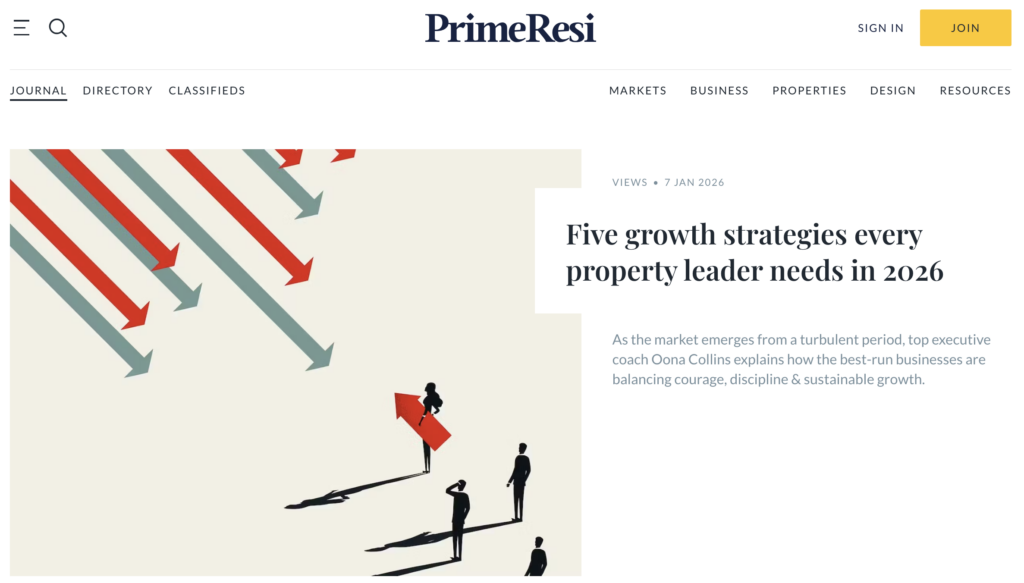
As 2026 begins, the residential property sector emerges from a period defined by inflationary pressure, political shifts and persistent planning uncertainty.
For many, the past few years have tested not only balance sheets, but belief. Yet within that pressure, leaders have taken the opportunity to pause, reset and refocus on what matters. The result is a cautiously returning confidence, and with it, the chance to move forward with greater clarity and resolve to shape sustainable growth in the year ahead.
As one Managing Director of a residential development company recently said to me “2026 will be a year of controlling costs, maximising revenue and seeking new opportunities for growth.” His advice to his team was simple but powerful: be brave and be financially prudent.
“Bravery and prudence are not incompatible with an aggressive business model, …Go out and fight for it, but take a breath first and ask yourself: do I really want this opportunity?”
That balance between courage and control will be important for business leaders in 2026. The year ahead will demand clarity of purpose, disciplined execution and the confidence to make bold decisions while keeping a firm grip on fundamentals.
Here I look at five leadership strategies that will help build sustainable growth, both in the short term and for the years beyond.
1. Start with the Truth: Look Inward Before You Look Outward
Sustainable growth begins with honesty.
I recently worked with a property consultancy that had built an exceptional business from the ground up, becoming a recognised market leader. Their early success was driven by hunger, instinct and deep technical expertise. But as growth slowed, the Equity Board recognised a familiar truth: what got us here will not get us there.
To unlock the next phase, they had to return to first principles. What were they truly known for? Where did they add the most value? And where, slowly and unintentionally, had they drifted?
Through candid conversations with each other and with clients, they identified which services and values were core to their identity and which needed to evolve or be let go. That clarity became the catalyst for renewed momentum.
How often do you pause to take an honest look at your business and ask what is really working…and what isn’t? The answers can be uncomfortable. But they are often the ones that sharpen strategy, restore focus and unlock growth.
2. Think Laterally, Act Intelligently
In a volatile market, knowledge alone is not enough. It is how you apply that knowledge that creates advantage.
In my conversations with property leaders, several have noted that 2026 will be shaped by how companies respond to evolving planning policies, particularly when there is uncertainty over how long those policies may remain in place. Others have highlighted the growing disconnect between national planning frameworks and local authority implementation.
One executive suggested that continued inefficiencies could frustrate landowners to the point of risk aversion, potentially creating opportunities for well-capitalised, agile businesses to acquire land at more favourable terms. Some are already ring-fencing reserves so they can act decisively when those moments arise.
The message is clear; leadership teams must be well-versed in policy, regulation and market signals, but more importantly, they must create space for brave conversations.
Regular, structured dialogue that challenges assumptions and explores unconventional opportunities for growth is where real strategic power lies.
3. Build the Framework Before the Pressure Hits
There is a persistent myth that structure stifles entrepreneurialism. In reality, the opposite is true.
The most resilient, high-growth businesses put simple but effective frameworks in place before they need them. A clear three-year plan with defined priorities reviewed quarterly. Robust CRM systems that protect and grow client relationships and enable the sharing of knowledge. Decision-making processes that encourage challenge and diverse thinking, so leaders can act with confidence.
Role clarity and accountability matter more than ever, particularly in fast-moving environments. And meetings should have purpose: clear agendas; strong facilitation; and a focus on gaining input rather than information sharing.
I’m reminded of Gareth Southgate’s approach as England manager – he deliberately spoke last in team meetings to avoid influencing the narrative. Leadership is not about having all the answers. It is about creating the conditions for the best thinking in the room to surface.
Often, it is the simplest structures that make the biggest difference.
4. Invest in the Reasons People Stay
Growth is not driven by strategy alone. It is sustained by people.
An asset manager who has spent many years with the same organisation recently shared with me the reasons why she has stayed. She said she feels genuinely appreciated and valued. She is trusted to work on high-quality projects, paid fairly and part of a business that is transparent and ambitious for its people. It celebrates success and shares profit in a meaningful way so that everyone benefits from what they collectively achieve.
In short, she feels she belongs.
Whether your ambition is to scale or to remain intentionally small, retaining great talent is non-negotiable. In challenging markets, replacing experienced people is harder, slower and more expensive. Investing in culture, fairness and opportunity is not a “soft” priority, it is a commercial one.
5. Turn Fear into Forward Momentum
Fear is the constant companion of ambition.
Every meaningful growth phase, whether stepping into leadership, launching a new venture or making a high-stakes strategic decision, comes with uncertainty.
I have seen individuals leave the perceived safety of large corporates to build something of their own or move into smaller organisations where the rewards are higher but so is the personal accountability.
This discomfort is often labelled imposter syndrome. I prefer a different framing.
Fear frequently shows up when we are stretching into something bigger. When reframed as evidence of ambition rather than inadequacy, it becomes a powerful source of energy. In a sector where decisions are complex and the stakes are high; mindset is not optional – it is foundational.
Entering 2026 with Clarity and Conviction
The property sector will continue to evolve in ways none of us can fully predict. But some things remain firmly within your control.
Get clear on your direction. Define the roles and capabilities that will take you there. Put systems in place that enable, not constrain, growth. Create cultures where people want to stay, contribute and succeed together.
And remember: ambition is rarely comfortable. But growth almost never happens without it.
The leaders who will thrive in 2026 will be those who balance courage with discipline, think long term, and build companies where people feel valued, trusted and proud to belong.
Oona Collins works with leaders and their teams to support them in setting growth strategies. If you are looking to nurture the ambition of your team and grow your business, contact Oona to begin a conversation at team@potentialplus-int.com
See what our clients have to say about us here.